Home Blog Page 17

Happy Holi Wishing Script | Festival Wishing Script

0

In this article, I will show you how to create a website of wishes for the festival and in this publication, I will tell you how you want to create a Happy Holi Wishing script website for WhatsApp and earn money from your desired website and this Happy Holi It is very easy to create a site desired website because. I will give you my Happy Holi script for free so you can edit it. And make it yours.

This is also for the blogger of Happy Holi scripts and you know that this type of blog is known as event blogging and knows that event blogging is a very fast way to earn money. And if you create a festival-oriented website, your content is more likely to be viral. And you know that if your content is viral, it pays you a lot of money.

Also, read them

Below is how to create Happy Holi Wishing Script so you can facilitate it and, if you liked this article, share it with your friends and I sincerely hope you can earn so much money with this Happy Holi Wishing website.

Happy Holi Wishing WhatsApp script

Happy Holi, the festival of colors, is a beautiful festival in India. The importance of the festival is the victory of good over evil, the arrival of spring and the end of winter. Love, oblivion and forgiveness, mythology, form a relationship and fulfill another meaning of this festival. Holi is also celebrated as a thank you for a good harvest. The full moon day is celebrated in the Hindu calendar of Laguna Samvat Lagun. Somewhere between February and March in the English year.

How to make money using the Holi Wishing Php script:

Buy an exact match domain or use a free Freedom World domain.

Method 1: social exchange

Share this script on Facebook and the WhatsApp group for a week or a month. You can find many WhatsApp group invitation links on the Internet. Find them.

Method 2: comment on the event blog website

You can already find many ranking blogs with keywords such as Happy Holi 2019, Happy Holi Wish Messages, Holi 2019 Whatsapp Images, Pictures, etc. Start commenting on your blog list now. Insert the Adsense code below and above the script. Your website will go viral and earn money.

How to Download Free Holi Wishing Viral Wishing Script

Ya sabhi wishing script me aap Happy New Year Quotes, PNG Images, Images, Gif Images, Timers, and Share Button. Diya hu aap yaha se shaare script ko Live Preview. kare ke dekh sakte hai.

Happy Holi Wishing Script Features:

  • Adsense Friendly
  • Change Any Image & Text
  • Optimized for High Ads Revenue
  • Facebook & Whatsapp Share Button
  • Very Light Weight with Super High Speed

Happy Holi Wishing Video Wishing Website Script Download Link:

Happy Holi Script Code Details:

  • Favicon: favicon.png
  • Background Color: #FF0000
  • Background Stars: flowers.gif
  • Side Image 1: trishula-durga.png
  • Side Image 2: lion.png
  • Glitters Code: Red-glitter.gif
  • Image 1: Happy-New-Year.png
  • Audio Player:
  • Image 2: Rakhi-PNG-Image-Transparent.png
  • Image 2: lion.png
  • Message: May the 9 avatars
  • Slideshow Code: slideshow-container
  • Slideshow Timer: setTimeout
  • YouTube Code: TIrrzcyfFqI
  • Adsense Code
  • Timer: countdown date

Note: When you customize these Wishing Scripts, definitely change the link on Social Media Share Buttons.

Also, read them

Please Like, Comment, Share THANK YOU!

Best Hosting Deals

  • BlueHost Hosting Discount
  • BlueHost Hosting Discount
  • A2 Hosting Discount
  • DreamHost Hosting Discount
  • GeneratePress Theme Discount
  • Mangools Toolkit Discount

How to use Soft Keys Home Back Button | Free Download

0

We know that there are several Android smartphones with non-working. Soft Keys Home Button and Back Button so we are going to show you how you can use your home button and back button with an android application.

Read Also:

In this case, you don’t have to root your android smartphone so let’s begin the simple three-minute process I want to remind you guys that we are providing direct download links.

How to Download Soft Keys Home Back Button :

Go to the menu and locate Google Play Store and tap once on it now go to the search bar and type back button and then search for the app “Soft Keys Pro – Home Back Button

Home Back Button

That once on it install the app and the file size is only 3Mb and it takes only 10 seconds to install the application on your smartphone

How to use Soft Keys Home Back Button

Open the app and this is what you should be seeing on your screen settings. And accessibility is a feature that allows you to make changes to the controls. Tap on it once and it will take you straight to the accessibility settings now scroll down.

Step:1

  • Open the app, enable permissions if asked Click the ” Permissions |Accessibility” button Find ” Soft Keys pro ” and enable it.
How to use SoftKeys Home Back Button Step 1

Step:2

  • Set location, size …
How to use SoftKeys Home Back Button Step 2

🎨Key Features:

 • Auto-hide navigation bar
 • Easy to wipe up/down to show/hide navigation bar
 • Functions: Home, Back, Recent
 • Ability to Set vibrate on touch
 • Options to lock navigation bar
 • Ability to change navigation bar with background and button color
 • Ability to set navigation bar size with height
 • 2 Themes Available
 • Long press action for back, home, recent buttons

Final Sentence:

YOU CAN EVEN DRAG AND DROP THE Soft Keys BUTTONS ANYWHERE ON THE SCREEN DO YOU NEED HELP THEN COMMENT BELOW FOR ASSISTANCE.

Read Also:

Off-page SEO: The Ultimate Guide

0

Off-page SEO is the set of activities that are done outside your website to lift the ranking of your web page or website in the Search Engine Result Page (SERP).

Read also: On-page SEO: The Ultimate Guide

What is Off-Page SEO?

Off-Page SEO” refers to all the activities that you and others do outside of your website to increase the ranking of a search engine page.

Although many people associate SEO outside the page with link building it goes beyond that. Many activities that do not result in a standard link on other sites are important for off-page optimization.

Search engine optimization on the page occurs within the site while SEO outside the page occurs outside the site. If you write a guest post for another blog or leave a comment you are promoting sites off the page.

On-page SEO vs. Off-page SEO

On-page SEO vs. Off-page SEO
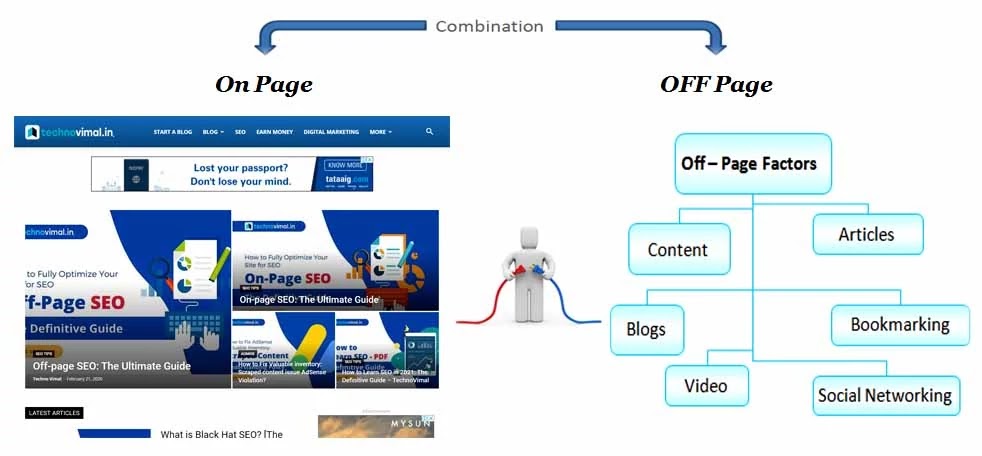
  • On-page SEO is everything you do on your site and over which you have total control. On the other hand, off-page SEO, as the name implies, is completely off-site.
  • On-page SEO factors include meta title, meta description, keyword research, image optimization, internal links, external links, keyword optimization, page speed, canonical URLs, content optimization, schema data, and many pluses. On the other hand, off-page SEO factors refer to domains, backlinks, guest posts, creation of broken links, influence marketing, comments, reviews, and social media marketing.
  • The important difference between On-page SEO and Off-page SEO is that there is some possibility that On-page SEO can only survive; It does not require the support of any other SEO technique. But off-page SEO cannot survive alone. You need the correct SEO on the page to work.

Read also: What is Black Hat SEO? 

Benefits of Off-Page SEO

A website with the right Off-page SEO gives you a great many advantages:

  • A website can rank higher within the program result page (SERP).
  • It ensures that your website can get maximum organic traffic.
  • Off-page SEO also increases the domain authority of the web site.
  • Off-page SEO results in an increment within the referral domains.
  • Your site can establish an honest trust with Google, which is overall the foremost important factor once we count the advantages.
  • Regular and better growth of your website means your site can generate extra money.

Importance of Off-Page SEO

If the SEO on the page is the basic component for the classification of an Internet site, then the SEO outside the page is the backbone.

  • Google takes all SEO factors off the page when ranking a website.
  • The link ensures organic traffic. Experts recommend that backlinks can generate economic amounts of traffic for your website.
  • High traffic ensures a higher ranking, and there is no better option than off-page SEO to get traffic.
  • Off-page SEO is important to understand how the planet cares about your website.
  • Off-page SEO guarantees a better PageRank and authority on your site if removed properly.
  • Under SEO off the page, social networks are probably a proven one hundred percent way to attract a considerable number of viewers.

Why does off-page SEO matter?

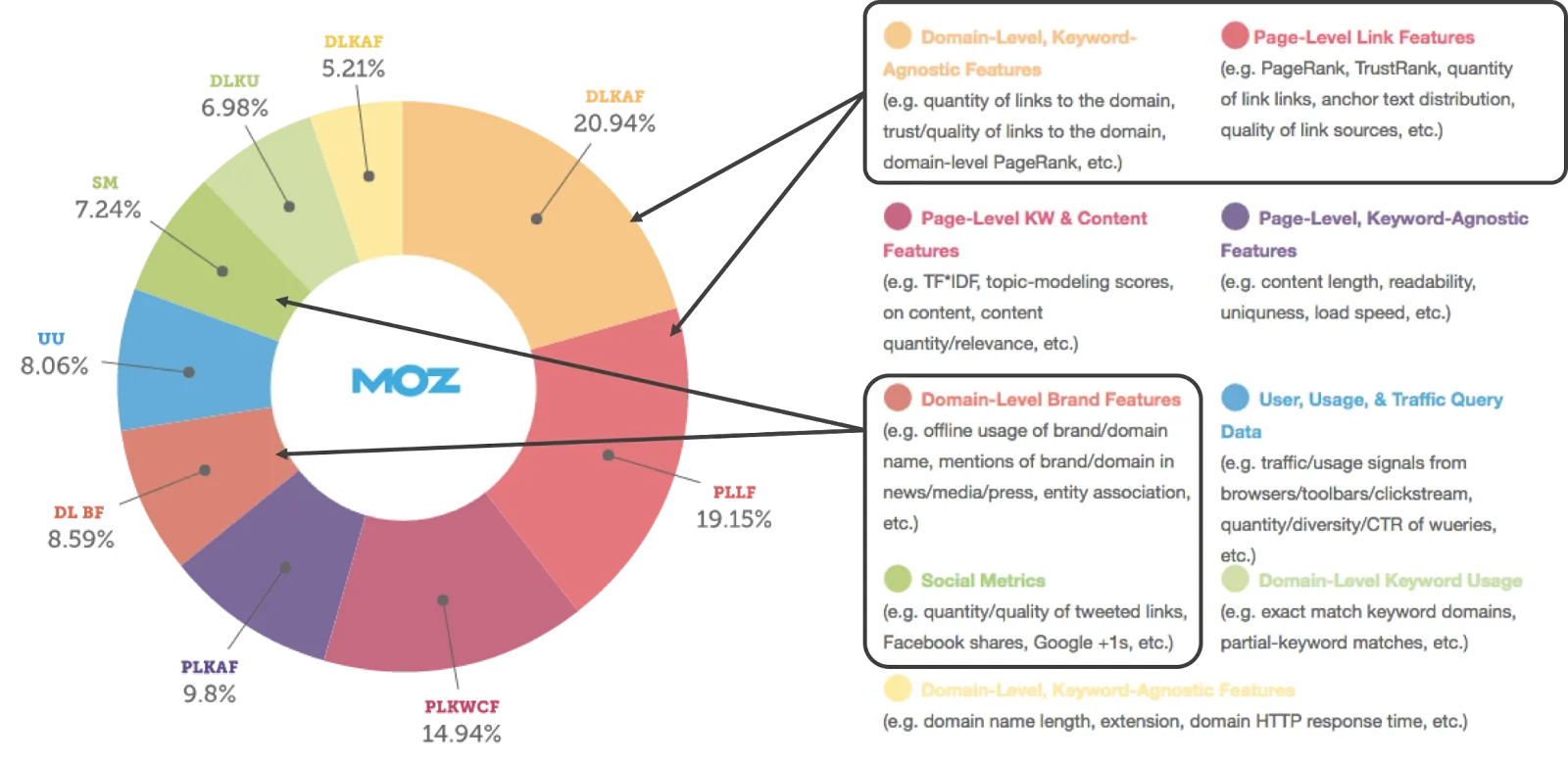
While search algorithms and ranking factors are constantly changing, the consensus within the SEO community is that the relevance, reliability, and authority of off-page SEO offered for a website still play an important role. In the ability to page rank.

While we do not know the full algorithm that Google uses to rank content, the data from our study of the search engine ranking factor shows that more than 50% of the weight of the factor in off-site SEO-related factors Classification is likely to occur.

Off-Page SEO Factors

You have to do off-page SEO in two ways, and both these ways are equally important.

  • Link Related Off-page SEO factors
  • Non-Link Related Off-page SEO factors

Link Related Off-page SEO Factors

Google’s search is based on the PageRank algorithm which focuses on the number of excellent backlinks to your website. Google’s PageRank algorithm has made it clear that good backlinks are highly needed pointing to your site.

Off the page are links related to SEO factors:

  1. Referring Domains
  2. Link Authority
  3. Dofollow vs. Nofollow Syntax: <a rel=”nofollow” href=www.example.com>
  4. Guest Posting (Guest Author)
  5. Broken Link Building
  6. Anchor Text Syntax: <a href=”http://www.example.com”>Enter your Anchor Text here</a>
  7. Relevance
  8. Traffic

Non-Link Related Off-page SEO Factors

The off-page SEO link factor is of great importance but there is no doubt that the off-page SEO factors not related to the link are equally important.

The off-page SEO factors without a link are:

  1.  Business Listing
  2.  Brand Mentions
  3. Commenting
  4.  Influencer Outreach
  5. Google My Business
  6.  Reviews
  7. Social Signals

Conclusion

Off-page SEO is nothing without On-page SEO. Though Off-page SEO seems harder than On-page SEO. The factors under Off-page SEO aren’t under your control so it’d take time to realize a specific result. Do share your views regarding this text. Was it informative? The comment box is all of you to share your queries.

Hopefully, this tutorial was helpful. allow us to know within the comments below if you face any issues.😊

Best Hosting Deals

  • BlueHost Hosting Discount
  • A2 Hosting Discount
  • DreamHost Hosting Discount
  • GeneratePress Theme Discount
  • Mangools Toolkit Discount

On-page SEO: The Ultimate Guide

0

On-page SEO refers to the optimization of sites by various practices like content optimization, keyword research, meta tags to rank higher within the program result page (SERP).

What is On-Page SEO?

SEO on the page (also known as SEO on the site) refers to the practice of optimizing sites to increase the ranking of programs on a website and gain organic traffic.

In addition to publishing relevant and high-quality content, SEO on the page involves customizing your title, HTML tags (title, goal, and header) and images. It also means guaranteeing a high level of experience, authority, and reliability on your website.

This takes into account several aspects of the website, which when added, will improve the visibility of your website in the search results.

Read: Off-page SEO: The Ultimate Guide

Why On-Page SEO Is Important

SEO on the page is important because it helps search engines understand your website and its content, as well as identify if it is relevant to a search engine query.

As search engines become more sophisticated, search engine results pages (SERPs) focus more on relevance and semantics.

Google, with its vast number of sophisticated algorithms is even better now:

  • Understand what users are really looking for when they type a query.
  • Providing search results that meet user objectives (informative, shopping, navigation).

Adaptation is essential with this development, and you can do this by ensuring both the content that is visible to users and only those elements on your web pages (such as text, images, video or audio) is visible in search engines (such as HTML tags, structured data): the latest best practices. Accordingly, they have been well adapted.

Also you should not just avoid SEO on the page because unlike off-page SEO with external signals (that are, backlinks) you have more control when optimizing content on the site.

If you follow the strategies on the page, you will see an increase in traffic and an increase in your search presence.

This guide will guide you through the most important elements of SEO on the page.

Paying close attention to these 10 areas will help you improve your content and authority and increase your rankings, traffic, and conversions.

15 Useful On-Page SEO Checklist:

1. Meta Title

Meta titles play an important role in website rankings. If your headline is satisfying, just bother people to click on it. Modern Google algorithm requires that the title be between 50 and 55 characters long. Contemporary Google settings show titles of 50-55 characters in length (space included), and the rest are hidden.

Syntax: <title>Your Title Here Like this.</title>

On-page SEO: Meta Title

2. Meta Description

Meta description tags are used to show an overview of their content for both users and search engines.

The meta description must be between 150 and 160 characters because the search engine only shows descriptions of up to 160 characters.

If your meta description is good, there is a possibility that your content will appear in the featured snippet of the search engine results page (SERP).

Optimizing meta description correctly can help improve:

  • Click-through rate (CTR).
  • Perception of the quality of the result.
  • Perception of what your website offers all change

Syntax: <Meta name=” description” content=” the description which you want to display”/>

the description which you want to display

3. Keyword Research

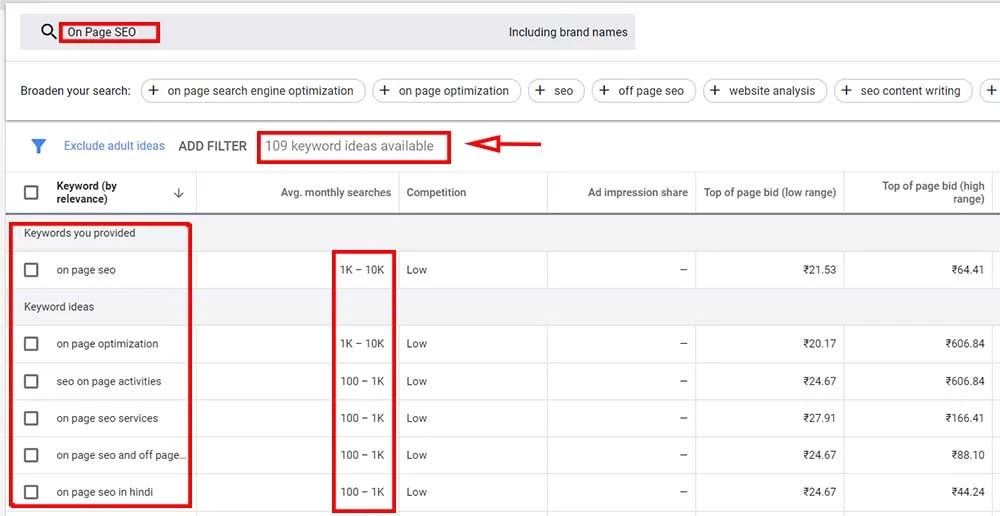
Keywords are an important part of SEO. Keep checking the foremost searched keywords using the simplest SEO tools and post content only on them. you’ll use Google Keyword Planner, Keyword Everywhere, Ubersuggests, AnswerThePublic.

Target the keywords that have an inquiry volume of 1000+ searches per month. you’ll target the keywords like Informative keywords (For example, SEO and Blogging), Transactional keywords (For example, keywords including ‘best’ and ‘top’ word), Location-Based keywords.

Always add the keyword in your title and meta description. The focused keyword should be present 5-6 or more times within the article, counting on the content length. Also, use the target keyword within the first 100 words of your content.

On-page SEO Google Keyword Planner,

4. Heading Tags

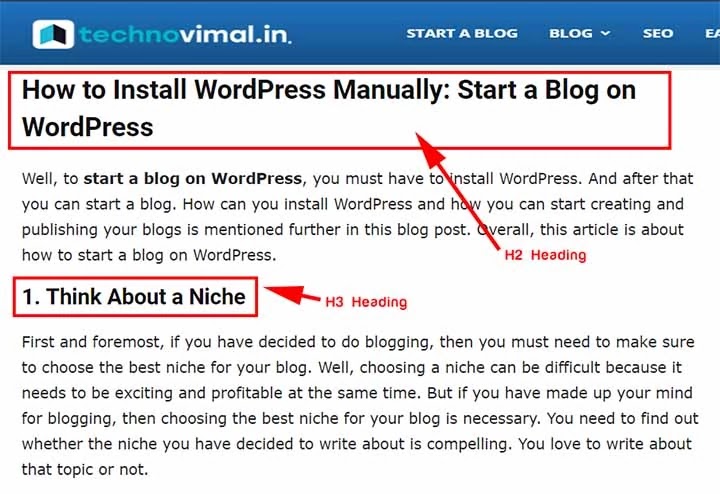
Title tags are HTML elements (H1-H6) that are used to identify titles and subtitles of other types of content (for example, paragraph text) in their content.

Title tags are not as critical for the ranking of your site, as these provide an important function for your users and your SEO.

These may indirectly affect your classification:

  • Make your content easier to read and more enjoyable.
  • Provides rich keyword context for your search engine content
Heading Tags

5. User-Friendly URLs

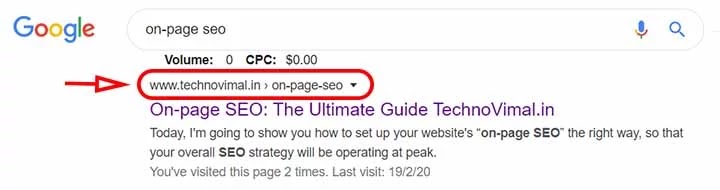
Your priority should be the user because if you’ll satisfy the user, meaning you’ve got already met the wants of the program. Make use of SEO-friendly URLs and concentrate on the primary three to four words of it because shorter URLs rank far better.

Avoid using lengthy URLs like https://technovimal.in/what-is-blog-and-how-does-it-work-in-2020

Avoid using ugly URLs like https://technovimal.in/2019/03/11/what-is-blog-blogging-blogger/

Try using URLs as simple as https://technovimal.in/how-to-start-a-blog.html

User-Friendly URLs

Conclusion

SEO on the page is the basics of SEO. This is more than fools if you do not optimize your website content and switch to other SEO media. As an SEO suggestion, always use the keyword in the first 100 words of your post. I hope you found this SEO guide on the information site.

Let me know in the comments if anything is not clear.

Fix Valuable inventory: Scraped content AdSense Violation

0

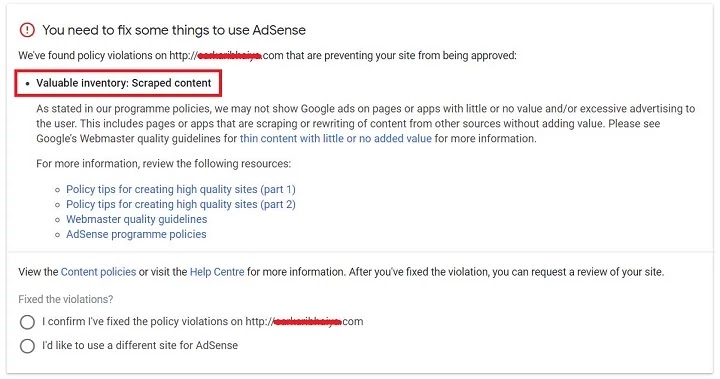
Completely fix Valuable Inventory: Scraped Content – When you apply for Adsense for some time, your account will not be approved due to a valid inventory scraped content issue.

So here we are going to discuss this article. “How to fix the error of Valuable Inventory Scraped: Content Adsense Policy Violation?

{ Read:- How To Fill Invalid Clicks Contact Form For Your Suspended Adsense Account | Invalid Traffic Appeal }

Before going to the AdSense approval.

Make sure your website is fully developed. Your website should have unique content. I said it is unique it means it is written by itself not copied, scraped from other articles.

Scraped Content Violation

What is scraped content?

Scraping content is taking content from other places on the web and publishing it on your own site.

There are many websites that only have parts or content stolen from other websites. Many sites will take articles from other websites and publish them as if they were their own, or copy entire websites.

This behavior goes against Google’s guidelines and copyright laws in the United States and other countries.

It is worth taking the time to create original content that configures your site. This will retain your visitors and provide more useful results for users who search on Google.

Some examples of scraping include:

  1. Sites that copy and republish content from other sites without adding any original content or value
  2. Sites that copy content from other sites, modify it slightly (for example, using synonyms or automated techniques) and republish it
  3. Sites that reproduce content from other sites without providing some type of organization or benefit unique to the user
  4. Sites dedicated to embedding content such as videos, images or other media from other sites without sufficient added value for the user

How & Why webmasters perform scraping on their blogs?

Singularity is important for Google and for all readers on the Internet. Therefore, producing unique, authentic, correct and valuable information for readers will always be fruitful in blogs for you and your long-term blog.

It is not a good idea if you copy from a large website to create good articles on your site so that your AdSense is approved or you can gather some traffic.

As a blogger, you should focus on the interest of your visitors, their demands. Do proper research and then write unique and relevant content for your blog readers. Not just waste material!

Understanding “Scraped Content.”

  • The content was published on site A.
  • Site A was disconnected and content moved to site B.
  • Site B was disconnected and the content was not available on the web.
  • The content was available on Wayback Machine.
  • I started site C and republished the content.
  • Site C is marked as “scraped content”, although there is only one version available online.

How to fix the “Valuable Inventory: Scraped Content” Adsense violation?

  • Check your article for plagiarism. If you don’t know which item is plagiarized or scraped.
  • Don’t copyrighted images, videos or other copyrighted data.
  • Do not write other blog posts with exactly the same word.
  • Place too many ads
  • Check the theme easy to use.
  • Add privacy policy, disclaimer, DMC page.
  • Remove most plagiarized publications or edit until they are 100% original.
  • Write some more posts and request Adsense again.

Conclusion

Fix valuable inventory scraped content – I have been blogging for the last three and a half years. I have seen many changes in Google AdSense policies. If you read them you can easily understand that they are always focused on the direction of the reader and the behavior of the advertiser.

Best Hosting Deals

  • BlueHost Hosting Discount
  • BlueHost Hosting Discount
  • A2 Hosting Discount
  • DreamHost Hosting Discount
  • GeneratePress Theme Discount
  • Mangools Toolkit Discount

How to Learn SEO in 2021: The Definitive Guide

0

Learn SEO in 2021: SEO (search engine optimization) is a process to attract organic traffic or visitors to your website or website by making it available in the main search results for a particular keyword searched by the user.

Reading time: 17 minutes 15 seconds

What is Search Engine Optimization (SEO)?

In the current era websites are at the level of need. Creating a website to do is an easy task in itself and it is even more comfortable if you do it in WordPress. What else do you need besides designing and configuring your website? The answer is search engine optimization. You must be thinking what is SEO?

Search engine optimization (SEO) is the most important thing or an essential requirement for website ranking can be said. Hearing this you might consider it the hardest part. But the answer is no. If you have the right guide then nothing is impossible in this world.

I hope you are well versed in SEO Earth. In addition to the definition of SEO this article tells you everything you need to know about search engine optimization from basic SEO terminology to the importance of SEO.

Basic Concepts of SEO

What do you think is better to jump directly to real-world SEO techniques to skip native ones? Beginners in a hurry to achieve it can leave it. But you never know what step you are missing and how much it matters.

Imagine what you would have done in your preprimary class on the first day of school they gave you to write an essay. Of course you cannot write a single letter because it is not transparent about its basic concepts or has studied A B C D. Now you understand how important the basic concepts are.

Similarly the basics of SEO have the same importance as do advanced SEO techniques. The basics of SEO include:

  1. Know your audience: for best results you must know your target audience. Whether you want to target people from the USA. UU. United Kingdom India or anywhere in the world.
  2. Know your competition: keep track of your competition what they are doing and what they are offering. Winners are those who never underestimate their competitors.
  3. Keyword research: Make a list of the most searched keywords and try to use them 4 to 8 times in your content based on the length of the content. You can use several keyword research tools available online.
  4. Site structure: this means how your website looks. It should look attractive and organized. In addition it should be easy to navigate. Almost every page of your website must be linked to one or more web pages on your site and must be created by considering yourself as a user.
  5. Title: a catchy and catchy title of a minimum of 75 characters and a maximum of 55 characters; Do not exceed the threshold to achieve a better CTR (click rate).
  6. Meta description: gives reasonable meaning in approximately 150 to 140 characters. If your meta description is good the probability of appearing in prominent fragments increases.

Example: <meta name = “description” content = “your description here” />

  1. URL structure : use   concise and descriptive URLs to make it as simple as possible which makes them easy to use.
  2. Canonical URL: used to indicate to the search engine that the master URL of a page is represented by a specific URL so that duplication of the content does not cause problems.

        Ejemplo: <link rel = “canonical” href = “master URL” />

  1. Content optimization: Create content so that users stay on your website for a longer time. Try to explain in simple and short words. Add compressed images (for example compress images of 120 kb to 50 kb or less) so your website takes less time to load.
  2. Screenshot Describing the truth: add screenshots because people believe more in what they see than in what they read or hear.
  3. The site must be suitable for mobile devices (responsive): most Internet users use their mobile phones to perform searches. Your website must be suitable for mobile devices. That is it must be adjusted according to the size of the mobile screen. You can view your website compatible with mobile devices or not through Google Pagespeed Insights.
  4. The site should load quickly: the site should not contain data in cache unused JavaScript and CSS files. And the images must be compressed to their original size so that the website loads faster. If a site takes longer to load the user can close it and move to another location.

Recommendation: If you want to start your blog in WordPress you can install the “WP Rocket” “MaxCDN” and the “Shortpixel” add-in to increase the speed of your blog/website page.

  1.  Stay updated:  keep track of what’s new; What are the latest SEO techniques? What changes Google is making to its algorithm and many others.
  2. Stay away from Black Hat SEO: this is a risky technique in the short term and is more likely to get into trouble. You must stay away from Black Hat SEO.
  3. Follow the guidelines for Google webmasters: you can’t be sure that what you are doing is right or wrong. So before doing anything follow the guidelines of the webmaster of  Google.
  4. Time   –   Monitor your website at the moment   – you probably don’t know that your SEO campaign is valid or not which can generate your site more leads and more sales. For all these things you should continue to measure your results from time to time.
  5. Active in social networks: social media marketing is the best way to reach your customers and know their interests.

SEO Terminology

Before reading more about search engine optimization they should understand the basic SEO terminology which helps them better understand the meaning of SEO. SEO consists of more than 200 essential words the most common of which are below the search engine optimization terms.

  1. Redirection 301: This is a permanent server redirection from your previous URL to the new URL without error “No”. Redirection 301 is a way of telling the search engine that the URL of the web page URL has changed.
  2. Alt Tag: This is a feature of the HTML image tag. The Alt tag is the text that is displayed when an image takes time or does not load.
  3. Anchor text: this is the text to which the second page is linked. In simple words, it is a text that works as a link to another page.
  4.  Link recoil: this is a link placed on the web page or website of another person who returns to his web page or website. The process of creating backlinks is called link building. There are two types of backlinks: dofollow and nofollow.
  5. Black Hat SEO: This is an unethical or inappropriate SEO technique that goes against  Google’s guidelines.
  6. Canonical URL: This is the master URL of your web page that tells the search engine to retrieve it as a master or main URL (4 domain versions: www non-www HTTP https) which you can send to your visitors I want to see SERP.
  7. Tracking: This is the process by which search engines find new or updated content (web pages images videos and many others).
  8. CTR (  click rate ): is the relationship between the number of clicks and the number of users who visited the particular web page to which that link exists.
  9. Deindexed: this means that your website or website has been removed from the search engine index and therefore does not appear in the search results.
  10. Do-follow: these are links from one site to another which gives SEO credit. In simple words, it provides a backtracking link to other websites.
  11. Domain Authority (DA): This is a search engine ranking score of a third-party tool that describes how well you rank a website.
  12. External links: these links point to a domain other than the region in which they exist.
  13.   Function fragments: also known as enriched fragments it is an organic search box that appears at the top of the search results after the search.
  14. Google Search Console: This is a free program provided by Google which uses the owners of the site to verify how their website works in the search.
  15. Header: This is the text that is placed in the HTML header tags that are H1, H2, H3, H4, H5, and H6 tags.
  16. Inbound Link: This is a link to your site from another site and is considered one of the best ways to increase the rank of your website.
  17. Index: An index is a database where all search engine data is stored. If a page is indexed it appears in the search results of a particular keyword.
  18. Indexing: this is the process of collecting and storing data for future use by search engines.
  19. Internal links: internal links are links that point to a page on other pages of your website.
  20. Keyword: this is any word entered by the user in the search box. It is the most searched word.
  21. Keyword density: this is the percentage or number of times a keyword appears on a web page.
  22. Link creation: this is the process of getting more and more inbound links to drive traffic to your website.
  23. Meta tag: this tells the search engine what your post or website is in a couple of words. Includes meta descriptions and meta keywords.
  24. Nofollow: This is a link from one site to another which does not grant SEO credit to the other website. In simple words, there is no vote or any link to the search engine index to notice this.
  25. SEO on the page: it is the SEO that you perform on your page to improve your ranking. For example internal links improvements in keyword density and some others.
  26. Off the SEO page:   – This SEO hat off your site to improve your positioning – for example, Link building.
  27. Organic results: in addition to the ads the results that appear for a particular query are organic results.
  28. Organic search: enter any word in the search box click on the search button. This is an organic discovery.
  29. Page Rank (PR): This is an algorithm used by Google to rank web pages which defines the importance of that web page in the ranking factor.
  30. Organic traffic: in addition to the unpaid or natural search results that lead to your website they are called organic traffic.
  31. Page Authority (PA): This is a search engine ranking score that defines how well a web page is ranked in the search results.
  32. Page view: When a visitor visits a website it is known as a page view.
  33. PPC (pay per click): PPC also known as CPC (cost per click) is an online ad that users pay when they click.
  34. RankBrain: This is Google’s current updated algorithm that processes relevant search results.
  35. Site map:site map is a list of all the pages available on your website.
  36. SERP: means a search engine results page. These are the results pages you see after searching.
  37. Spider (tracker bot robot): The Spider search engine informs new sites new content and reports to verify the data so that the search engines can index and classify them.
  38. URL (Permanent Link): The Uniform Resource Locator is the address of a particular web page.
  39. White Hat SEO: This is a type of ethical SEO technique that follows Google’s guidelines.

If you want a deeper understanding of these SEO terms you can consult my article on SEO terminology.

How does SEO work?

The main objective of search engines is to provide the user with high-quality content and the best services that can meet the user’s search objective. You can achieve this only by optimizing the web pages through search engine optimization. I know that search engine optimization is a complex process but to be honest it’s not that complicated.

The questions you can think of how will SEO work? How can a search engine identify pages that are relevant to your search? How can search engines identify the best content and rank web pages? Let me answer your question.

To know how SEO works you must be clear with the basics of SEO. Once you apply all the necessary SEO techniques your work will be over and it’s time to start working for the search engines.

The search engine scans all websites on the Internet to know your site and then continues to work.

The search engine follows three steps to identify the relevant and best content for tracking indexing and ranking.

  1. Tracking: This is the first step in which search engines send their team of robots such as crawlers spiders or bots to discover what’s new on the Internet and what content is updated. The content not only includes an article but it can vary from an image video PDF to audio content.
  2. Indexing: Any crawler spider or bot that collects search engine information is stored in the search engine database. Note that not all crawled web pages are also indexed. You must make your content good enough to be indexed.
  3. Classification: the order of the lowest result of the best result (10 blue links) is known as classification. In other words you can say that the results are ranked in order from best to the poor.

SEO Types

There are three types of SEO. If you want your website to rank well you must do all three types of SEO:

1. On-page SEO

This is SEO that you do on your website or website to improve your ranking. SEO on the page is the most basic type of SEO you need to understand because when SEO on the page of your website is not perfect how can you expect other SEO techniques to make your site top the list? The

The most important thing to do in SEO on the page is the proper keyword research. See the most searched keywords and add them to your content. In addition to keyword research it also includes internal links the most important technique that underlies meta tags meta descriptions text formatting fast page loading the era optimized for mobile devices and other SEO on the page.

You need to work extremely hard on your content as it is the only thing that attracts visitors. Create a masterpiece with a catchy title.

You must start with the content to be excellent; You only have 10-12 seconds to impress a visitor to stay on your page for longer. Google takes a count of how long a visitor stays on your website. Therefore the longer a visitor stays on your website you can offer a better ranking in search engines.

2. Off-page SEO

Off-page SEO is the technique that you apply outside of your site after performing SEO on the page. Most beginners are often confused with the fact that off-page SEO only involves link building. But this is not the truth; It is not limited only to link building. It works with backlinks guest blogs social media marketing social bookmarking and some others.

3. Technical SEO

If your technical SEO   is not perfect then there are chances that all your SEO work is in vain. It deals with the tracking and indexing of websites. It provides a good user experience which helps search engines understand the quality of the website.

Technical SEO includes technologies such as JavaScript Sitemaps Optimizing Robots.text and URL structure Site Speed Website Infrastructure Mobile Friendship Instant Mobile Pages (AMP) Security Canonical URLs and some more.

Once you have completed the correct technical SEO you do not need to repeat it again and again. Instead you just need to verify regular SEO audits.

This was a summary of the types of SEO which I think is not enough. But you should not worry because I have prepared a complete article on how many types of SEO for a better understanding.

Seo technique

There are three main types of search engine optimization techniques:

1. White Hat SEO

Google WebMaster provides some SEO guidelines that a website owner must follow. A white hat SEO technique is the most ethical way to optimize the search engine because it follows Google’s webmaster guidelines and maintains the integrity of the website. It refers to techniques that help improve the ranking of the website.

Although it takes more time and money White Hat SEO is the most used and long-term SEO technique with the least chance of risk. Some basic White Hat SEO techniques include quality content fast site load time link building backlinks easy to navigate website good keyword density and some others.

People who use white hat SEO techniques are more successful than those who use other SEO techniques.

2. Black Hat SEO

If you are looking for a way to gain popularity quickly you can use the Black Hat SEO technique. But let me remind you that you are using it at your own risk. I say this because Black Hat SEO technology is not ethical they do not follow Google’s webmaster guidelines they violate them. It is profitable so maybe you can save your money but not in the long run. Because it is a short term technique and the risk is high.

There may be times when your web page or website may be blocked in search results for violating search engine guidelines. Your website may end in search engine penalties.

This technique only degrades the quality of your website and reduces its ranking. Black hat SEO techniques include unnatural links paid links cover-up keyword stuffing misleading redirects blog comment spam abundant fragment tagging spam and some others.

3. SEO Gray Hat

Gray Hat SEO is the technique that is between the other two SEO techniques. It does not violate or follow Google’s Webmaster Guidelines.

And let me tell you that this does not mean that Gray Hat SEO technology is ethical. However this will not result in a search engine ban on your site. However it is not considered the safest route to follow this technique. Instead it is risky.

Gray hat SEO techniques include buying links duplicate content buying old domains buying social media followers exchanging content link farming unethical redirects and some others.

As advice it is better not to use SEO techniques that violate the Google Webmaster Guidelines.

Importance of SEO

Let me tell you a surprising fact that the keyword “SEO” has been searched for more than 100k per month which also knows that it is not for a low count. You must ask yourself why people search so much about SEO why everyone competes to learn SEO techniques. What is the importance of SEO? The answer to your question is found in my most beloved and shared article about the importance of SEO although 10% of the key points are also mentioned here.

Believe it or not but search engine optimization is the only way to take your website blog or online store to unattainable heights and ensure a huge amount of traffic. Search engine optimization is necessary for several reasons:

  1. Most users prefer to go through the first 5 or top 10 search engine results (SERP) pages of a particular query. And for your website or website to be among the first 5 or 10 best results search engine optimization is really necessary.
  2. If the website of your competition is also working well in that case the website optimized for search engines can attract many visitors or customers.
  3. Google is considered the most reliable search engine hence its search engine results page. Almost all Internet users visit Google once a day and there are billions of users. Therefore SEO is the best way to appear in search results and get organic traffic.
  4. It is important to know the world’s web environment in constant change. Without SEO you can never know the hottest topics in your niche. Search engine optimization ensures that you know the most searched keywords.
  5. Any strategy you adopt can make your website or blog famous but not for long. There is no better option than SEO to achieve a long-term effect.
  6. SEO can tell you how your website works in search engines its bounce rates pros cons how many clicks your website has and many more.
  7. This provides a completely different level of understanding for the public or their clients.
  8. SEO offers ten times better opportunities to get traffic.

Breast Benefits

I know you won’t use SEO unless you’re not aware of its benefits. Learn here some benefits of SEO that everyone needs to know.

  1. The main objective of SEO is to target quality traffic or in other words target organic traffic.
  2. The reason why website owners opt for SEO is that it is an inbound marketing strategy. That is it is a customer-centric approach to get traffic.
  3. SEO maintains the architecture of the website and facilitates the navigation of its users. Not only this but it also makes it easier for search engines to crawl your site and the quality content web pages it contains.
  4. SEO is profitable. You do not need to spend hundreds or thousands of dollars on ads.
  5. You do not need to invest much; You only have to spend the correct amount of time although the content you want to publish must be of high quality.
  6. You may have heard of PPC ads (pay per click). But you may not have heard of the fact that SEO is more efficient and faster than them. This guarantees 80% more clicks than PPC ads.
  7. SEO includes techniques such as link building keyword research which ensures organic traffic and is a long-term strategy.
  8. SEO helps you advance your competition.
  9. It provides a high click rate.
  10. For those who own an e-commerce website SEO helps increase sales and potential customers.
  11. It helps you monitor your weak areas and their fluctuations.
  12. SEO along with other marketing strategies increases the website ranking.

Let’s stop here because SEO provides so many benefits that it can take a full day of reading and even then there may be some left.

How has SEO changed over the years?

  1. Content quality: Previously Google did not focus so much on content quality but now the main focus has been on content quality. If the content is not correct Google does not consider anything else.
  2. Quality over quantity: Previously the quantity was considered more than quality but now everything has changed. Quality is a priority for Google. It doesn’t matter if you have some pages but they must be rich in diversity because a perfect web page is better than a hundred worthless web pages.
  3. Pay more attention to creating links: In the last decade Google counts the number of internal and external links regardless of whether they exist in the related content. But now as a change relationships that point to irrelevant content are exempt.
  4. User experience: Google is everything to the user; If you can make your users happy then there is no doubt Google tells.
  5. Keyword accuracy competition: Previously there wasn’t much competition for a single keyword. However now the game for keyword accuracy has grown so much that Google is considering several things to rank web pages.
  6. Changes in the Google user interface: fragments voice search podcasts site structure data and new changes in the user interface are some of the things that play an essential role in attracting traffic from Google.
  7. Link attributes: Previously rel-tag had only one attribute that is rel = “nofollow” for all paid sponsored UGC and untrusted links. But now the red label has three properties that are rel = “nofollow” rel = “sponsored” rel = “relc”.
  8. Mobile priority: this era is the era of mobile phones; Around 65% of traffic comes from mobile phones. Google focuses more on website optimization for mobile phones. Therefore each website owner takes this into account and creates a mobile-friendly website.
  9. Google Search Console (GSC): There has been a specific breakthrough in  Google Search Console or you can say that your pattern changed a few years ago.

Who needs SEO?

Everyone who owns a website blog or who has an online business needs SEO. SEO is definitely impossible without reaching the best results. Even if you offer the best content and the best products you still need SEO to lead the search results. Because the truth is that your contestants are already using it and hitting you. If you want to complete then you must have the help of SEO.

conclusion

Call it a revolution or a demand of the time but SEO is what you need most if you want your website to be located in hundreds. In short if you want to get ideas in thousands you cannot simply depend on their content; You need to do the right SEO.

Without search engine optimization you cannot achieve the desired results. Finally but at least you must be real with the fact that if you are not on the first page of the SERP you are not good.

I hope you found this article informative. What SEO strategy do you prefer? Share your thoughts in the comments.

You may also want to see: 

Best Hosting Deals

  • BlueHost Hosting Discount
  • A2 Hosting Discount
  • DreamHost Hosting Discount
  • GeneratePress Theme Discount
  • Mangools Toolkit Discount

If you liked this article, share it on the social networking site. You can also find us on TwitterFacebook, and Instagram.

What is Black Hat SEO? [The Ultimate Guide]

0

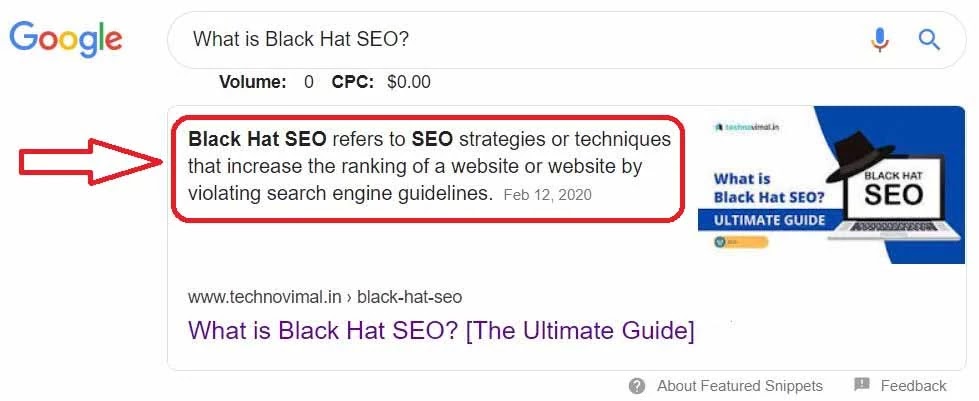
Black Hat SEO refers to SEO strategies or techniques that increase the ranking of a website or website by violating search engine guidelines.

Reading time: 8 min 5 sec

Black hat SEO tutorial, Black hat SEO techniques, Black hat SEO software, What is black hat SEO Quizlet. The black hat SEO course, Black hat SEO in Hindi

What Is Black Hat SEO? A Definition

Shortcut searches are human in nature, but do alternatives always guarantee success? This is a question you should ask yourself. You can be successful, but trust me, this success cannot last long.

Shortcuts are useful but do not guarantee long-term effects. My friend, that is SEO Black Hat, which is just an option to increase website ranking. To be clear, let me tell you that Black hat SEO is not a type of SEO, rather it is an SEO technique.

Black Hat SEO or Black Label SEO produces results soon, but it is for a short time. In addition, investment is much higher than white hat SEO.

White hat SEO is right, or you can say ethical type of SEO. This includes activities such as unique and relevant content, keyword research, infographic images, link building, fast-loading web pages, on-page SEO, technical SEO, and more. White Hat SEO ensures the success of long term effects. You can implement White Hat strategies without any doubt or doubt.

Technology is smart and Google Penguin is even smarter. If you have violated Google’s guidelines, you can track once in a while. Also, Google Penguin punishes you for this. Your website may be excluded from the Internet forever.

Black Hat Techniques in SEO

If you follow a strategy, you believe that the ranking of a website may increase, but it is not doing the user well. You are likely to have problems because Google considers it a Black Hat Act act. Therefore, you need to know what are the black hat SEO techniques that can cause big problems on your website.

Some known Black Hat SEO strategies are given below:

1) Duplicate Content

Duplicate content is the biggest crime in Google’s eyes. Duplicate content is not believed to work because content on some websites already exists on the Internet. So what is the need to reload it?

Plagiarism is the copying of material. It can be below 5% because there is a set of words like “on the other side” which another website could have used. And these words are not copied words. Instead, they are generic terms that can be considered less than 5% plagiarism.

If you are looking for a tool that can tell you whether your content is duplicate or not then you can use the Grammarly or Duplicate tool. It also allows you to verify plagiarism and other grammatical errors. Duplichecker is one of the best free SEO tools.

2) Cloaking

The most obvious explanation is that cloaking has to offer a piece of content to the search engine and a different piece to the user. Many spam websites cover-up to qualify for various keywords without being caught by Google robots.

An example of a cover-up is, suppose the user searches for a “type of fish” and comes to the page with prohibited content or pornography.

You can change the size of the web page for mobile users, translate the page into another language to facilitate user readability, or you can also change ads periodically. But changing the contents of the search crawler is not strictly accepted by anyone. Put your website at risk and cover it out.

To find out if your content is acceptable, ask yourself first, then search for particular keywords and read the top ten search results. I hope you find your answer.

3) Hidden Text or Links

This means hiding any text or link in the middle or the bottom of a web page or with a color like gray, white or yellow, or a color equivalent to the background that the search engine cannot see.

Google has mentioned in its blog that by placing text behind images, CSS is used to position text on the screen and set the font size of links or hidden text as violating Google’s guidelines is.

An unethical person uses this technique to introduce irrelevant keywords and links into content that the user or search engine does not notice.

 4) Unnatural & Irrelevant Linking

That link is required, as already mentioned. Adding wrong and irrelevant links to your content is also a black hat SEO technique. Adding links to other web pages on your website is good, but it should be relevant. Even if the link you provided is a high-quality authorization link but it is not related to the content, it may violate search engine guidelines.

If your content is about SEO? Can you add a link to your tiled content such as how to start a blog? Of course, you can’t. This is unnecessary, or you can say an irrelevant link.

Add links that are relevant and have some value. If your content does not provide all the details, you can add links related to another web page or website.

5) Content Spinning

Content rotation refers to the creation of a new article to give a new look by changing some words, a set of existing phrases, the format or sequence of phrases, sentences, paragraphs, or elements. Even after converting so much material, there is the right amount of plagiarism as such articles suffer penalties for duplicate content.

Article rotation or content rotation can be manual or automatic. Manual content rotation refers to changing the article automatically by reading it from top to bottom. Conversely, in automatic rotation of articles, use tools to rotate or modify the content.

Good content is the key to better ranking. Don’t mess it up by giving black hat SEO techniques.

6) Keyword Stuffing

Keyword padding is to refer to relevant and irrelevant keywords in each sentence. Irrelevant keywords do nothing but create a bad user experience, and the user closes their site after a few seconds. In addition, some keywords can categorize your website for a number of questions, which are not even addressed in content.

According to Google, keyword stuffing refers to the repetition of the same words or phrases that compromise readability. Repeated keywords create readability.

You can take the help of keyword research tools like keyword everywhere, answer-key ThePublic, Ubbersuggest. And find the most searched keywords, but it is not a good idea to mention them all in one post.

7) (PBN) Private Blog Networks

PBN (personal blog network) is a group of websites that interact with each other and form a guest publishing network. They evenly post on others’ blogs to get backlinks to their website. And they only approve requests for websites found in their personal blog network (PBN).

It is composed primarily of expired domains that have multiple backlinks. People buy domains that expire and change for backlinks to their websites and get SEO credits and traffic by adding backlink “Dofollow“. PBNs offer a large number of high authority backlinks with little effort.

Google’s algorithm takes a little time, but it tracks the PBN and punishes the website too much for illegally backlinking.

8) Reporting a Competitor

Falsely informing your opponent is a cheap and risky way of trying to top the charts. If your website is two years old and your competitor’s site is eight years old, and its content and ranking are much better than yours. Do you think Google accepts your complaint? Instead, he misidentifies you.

Do not inform you’re unnecessary competitors because even in SEO, there are ethics, and as an honest person, you should not leave people out of your way to snatch up your position. If you have the courage, you should take it on your own.

9) Spam Comments

Spam comments are comments in a blog post in which the commenter adds a link to your website. Many people use this Black Hat SEO technique to get links. However these links are “Nofollow”, meaning they do not give any SEO credit. Nevertheless, they help drive traffic to the website.

Comments like spam on my website for better details with links are spam comments. Previously, search engines counted these links, but now Google’s updated Penguin algorithm has started discounting these links. Although they maintain control over how much traffic comes from blog comments.

3 to 4 comments with links are fine, but hundreds of spam comments on various websites can cause major problems, and may even face some penalties from Google. Comments on blogs are a wrong or spam way to get links to your website, which is not allowed at all by Google search engines.

In addition, even your blog posts should not contain spam comments because Googlebot counts spam comments. You can use antispam tools and add-ons (such as Akismet) to detect and remove such comments from your blog.

10) Unnatural & Irrelevant Linking

That link is required, as already mentioned. Adding wrong and irrelevant links to your content is also a black hat SEO technique. Adding links to other web pages on your website is good, but it should be relevant. Even if the link you provided is a high-quality authorization link but it is not related to the content it may violate search engine guidelines.

If your content is about SEO? Can you add a link to your tiled content such as how to start a blog? Of course, you can’t. This is unnecessary, or you can say an irrelevant link.

Add links that are relevant and have some value. If your content does not provide all the details, you can add links related to another web page or website.

Conclusion

There are many Black Hat SEO techniques, although I have mentioned the most common ones. I suggest that instead of finding shortcuts to increase your site’s ranking, invest your time in doing white hat SEO.

Have you ever intentionally or not joined a black hat SEO strategy? Tell me in the comments section.

How to Make Money from Freelancing in 10 Easy Steps

0

Make Money from Freelancing. Not satisfied with the salary you get? Are you looking for part-time jobs? This is what you can do. Today, when prices rise from day to day, the salary of a working person remains the same. After hours of working so hard, what do you get? The answer is nothing. Do you know that you can make attractive money in your spare time? Yes, you can sell your service online, and you can earn money by working independently. Don’t worry, it does not mean that you are providing your service for free. You will be paid for this.

Many people do not really know that they can sell their services online. People look for people who are better at their work and can help them. For example, good people in digital marketing, social media marketing,  SEO, SEM, graphics and design, writing and translation, video and animation, music, dance, acting, computer programming, etc. are in high demand. There are endless people searching for good people in these jobs.

An independent professional is a person who is self-employed and does not depend on his employer. Nobody likes to be ordered by someone and normal corporate jobs pressurize him, sometimes they pressurize him.

Become a freelancer, teacher of your world. It is not important that you have to leave your job to be a freelancer, you can also take it as a part-time profession to earn a few extra dollars. Working for a freelancer can cost you $ 1- $ 100 per hour. Isn’t it amazing? Slowly and continuously you will gain experience and can charge more than $ 100 USD according to your demand. An independent professional fee per hour, day or project. A freelancer lives the life of a free desk worker.

Here are the Steps to Become a Freelancer

1. Set Your Job or Skills

The most important thing is to decide on your job. Do not look for two or three jobs at the same time, thinking that you will earn well. You can’t win anything with this thinking. Decide what is good, what your secondary skills are, this may include web design, copywriting, graphic design and more. Make sure you are the best at what you do. Everyone has some skills in which they are good. I am sure you also have an inner talent with which you are not yet familiar. You don’t even need experience; Freelance is also a platform for beginners. Believe in yourself Once you decide on your work, you can continue with your profile.

2. Choose a Niche

Now the question arises, how to choose a niche? Niche is a type of subject that describes an area or industry. It is like giving a plot of your work. Your niche should make people directly understand that their work is different from others and it is beneficial for them to strike a deal with you. People run towards brands. You have to create your own brand. Keep improving the quality of your work. Learn from your mistakes, live them. Experience is the best way to grow a brand. You may be confused or you may feel that there is a lack of data to decide the niche.

Here are some simple steps that will help you find an ideal niche:

  1. Ask yourself about your area of ​​interest, your hobbies, your passion, get suggestions from them.
  2. Be fully informed about your competition, find your niche and then create a niche that is better and different from them.
  3. Think like a customer, think about how you would look for an employee.
  4. Evaluate from the niche list you have decided.
  5. If you are satisfied that your niche matches the product, do it randomly twice.

3. Create an Attractive Profile

First, choose any of the independent platforms. The most famous place to work independently is the Fiverr I would suggest. Create an account on it; The steps to create an account in Fiverr are at the end of the article. Your profile should include your skills, previous experience, portfolio and qualifications if you have one. Upload proof of your work, such as photos, videos, documents, etc. If you are taking it as a part-time job or if you have decided to quit your job, then, of course, you have enough skills. Add all your important details which are necessary for the person to know your service. For example, if you are going to work as a content writer, upload some of your striking writing.

4. Learn to Trade

Business is something that requires experience, and you will never get experience without trying it out. If you are not sure enough, check out the profiles of others in freelance, read comments and visit at least 10 profiles. Do you verify what price they are selling their service? Learn from it First, do not set your rates too high or too low, because too little will give the impression that no one is hiring you, so you have reduced your rates.

5. Focus on Your Work

To equalize any business, the first requirement is that you must work really hard. It may seem difficult, but you cannot move forward without working. The first impression is the last impression, so be polite to your employer. Do not be discouraged by the number of questions the employer asks. If he is paying you, he will have hundreds of questions and it is your job to clear them. While working, consider the project conditions, deadlines, and quality of work (signed agreement). Do not lose your mind as soon as you get your first job. Think calmly and discuss time and budget. Make everything clear in the beginning.

6. Set Your Service Fee

Before posting about your service, decide your service fee. You can ask your friends, relatives, supporters or people who have some information about your work to help. You can also search for freelancers who offer jobs similar to yours. See her profile and comments on her page; Verify people’s requirements for that job. Based on this, set your salary. Think about your needs as well. You can continue to increase your price in the future based on your demand.

7. Set up a Billing or Billing System

Set up a billing system through which people can pay you. Many online payment sites have facilitated accounting and billing. Payment terms are transferred as an invoice. Evidence to be left to the employer or employee if there is a problem with respect to payment. The employer also specifies the project deadline and the amount to be paid via invoice. The freelancer, in turn, confirms your commitment by sending an invoice; It also confirms that you are charging by the hour or day. An invoice contains the cost, mode of payment, address of payer and beneficiary, etc.

You can use PayPal, Payoneer, Skrill, Payza, etc. For payment purposes. The best of these is PayPal. PayPal is a reliable international payment application and site that offers to send and receive money quickly and in an unsafe manner. In addition, your previous transactions can help you keep track of your profits and losses.

8. Make a Good Network

Socialize as soon as you establish a profile on any independent platform. Build a great network of people, tell them about the work you offer, ask them to spread the same thing. Share your free site links through social networks such as Facebook, Instagram, Twitter, LinkedIn, Pinterest, YouTube, Google+, email, WhatsApp and text messages.

9. Search for Projects and Start Bidding

You may not get any work or project in the beginning. But don’t stay idle, look for published projects, opportunity won’t knock at your door, you have to make an effort for it. Read the comment on the published project, start bidding. If a person offers a job for $ 50 per day, offer it for $ 40. Do not lower your price too much, as it can give an impression to the employer, who is a novice and who barely knows about the job offer. This will reduce your profile eligibility and also create a bad impression on your work. Comment on projects that have not yet been collected by anyone. Start with them, they can be a good start-up. Also comment on other people’s profiles. Introduce yourself to various blogs and websites.

10. How to Attract Customers

Socialize, ask your friends, family, old colleagues or other people to recommend their work to those people. Maybe you get some work. In many cases, this is a good way to start a business. Submit your work before the deadline; It should not look like it was done in a hurry, maintain its quality. It helps in building goodwill and trust among customers. You can also give them special discounts if you contact them a second time. Your good work will help you get good reviews and comments. People always go to the staff after reading reviews and comments.

Today, many people suffer from high blood pressure (hypertension), gastrointestinal problems, Alzheimer’s disease, accelerated aging, and the reason behind these diseases is stress, which occurs daily when working with someone. Sometimes a person is so irritated that he rarely talks to anyone and when he does, he is always angry.

The best sites that provide independent services are Fiverr, Upwork, Freelancer, WorknHour, PeoplePerHour, 99Designs, and others.

Nothing is impossible. Have faith in yourself and work hard, it will be easy to relax. Hello readers, I hope this article has helped you and you have got your questions answered.

How To Remove Date From Blogger Post URL – Make Blogger Permalink Format Like WordPress

0

Hello, guys today I want to talk to you about a quick trick. How to remove the date from the blogger post URL and create the blogger permalink format as WordPress.

In this post, share a step-by-step guide on how to remove a date from the URL of a blogger post.

Then stay with me until the end to know in detail. Every time we create a blogger post. This will include the publication date of that publication. Below is a screenshot of the Blogger default post URL.

How To Remove Date From Blogger Post URL – Make Blogger Permalink Format Like WordPress

But when you write a WordPress post your URL is completely different here the date and .html will not appear in the post URL.

The WordPress post URL blogger looks professional compared to the default post URL. So I recommend them to everyone if they have just started a blog on Blogger. Use this technique to extract dates from Blogger’s URL. This will make a Professional Blogger blog like WordPress.

Before This read here:

A permanent Blogger link is generated automatically and you can do it manually. But in both cases, the date will be. But with this method you can remove Blogger’s date in each post and even future posts will not have a date.

Benefits of removing the date of the Blogger post URL

A common search term that every blogger searches are how to remove a date from a blogger post URL or how do I remove date from Blogger’s permission?

Fist of all, tell me some benefits of removing the date from blogger post URL

  • Deleting the blogger’s blog post date will make your content evergreen.
  • Provide a professional permanent link to your blog post.
  • This will not allow visitors to know on which date the publication is published.
  • Helping the best rankings are search engine result pages.
  • Shorten your blog post URL.

On top of the profit you will get the date extracted from the blogger URL

How to hide post date in Blogger posts

Follow the steps given below and it will be finished in no time.

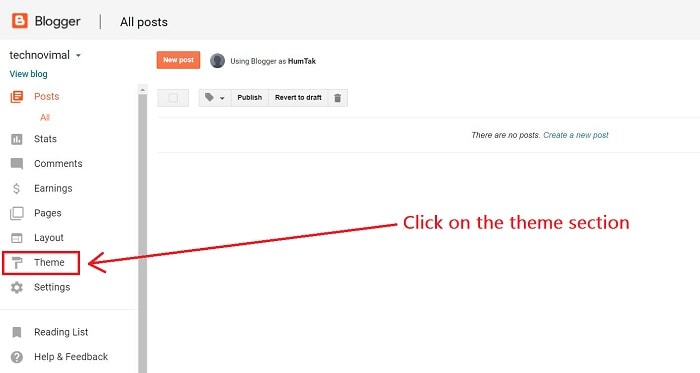
Step 1. Log into your blogger blog and select the theme/template.

How To Remove Date From Blogger Post URL

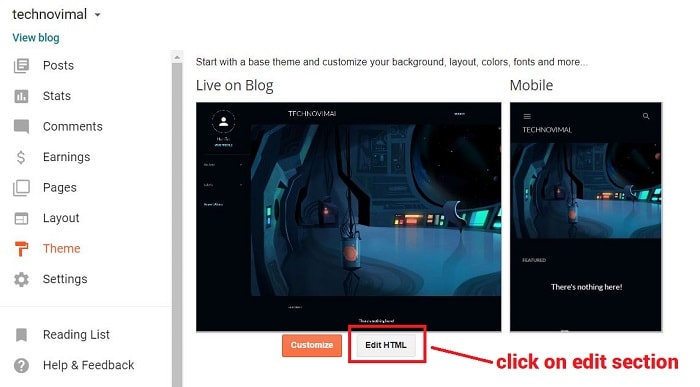
Step 2: After clicking on the Theme section, go to “Edit HTML”.

How To Remove Date From Blogger Post URL - Make Blogger Permalink Format Like WordPress

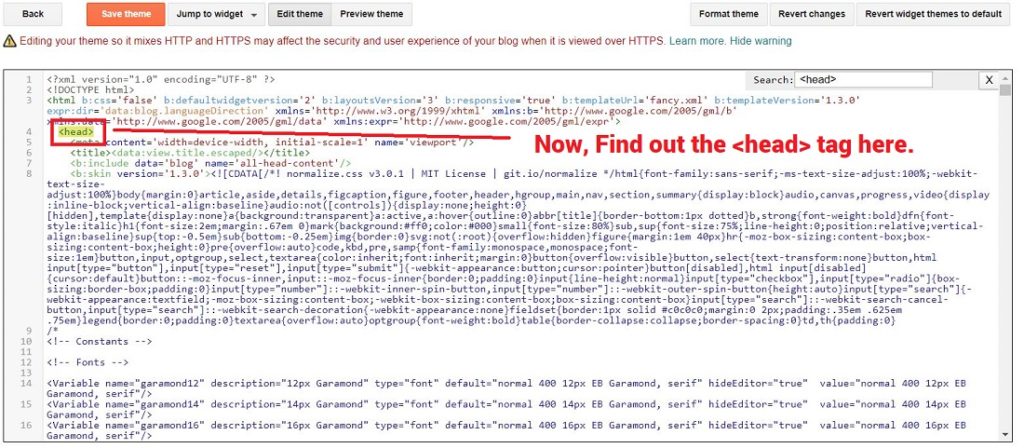
STEP 3: Now, locate the tag here. You can also search for it with the help of Ctrl + F.

How To Remove Date From Blogger Post URL - Make Blogger Permalink Format Like WordPress

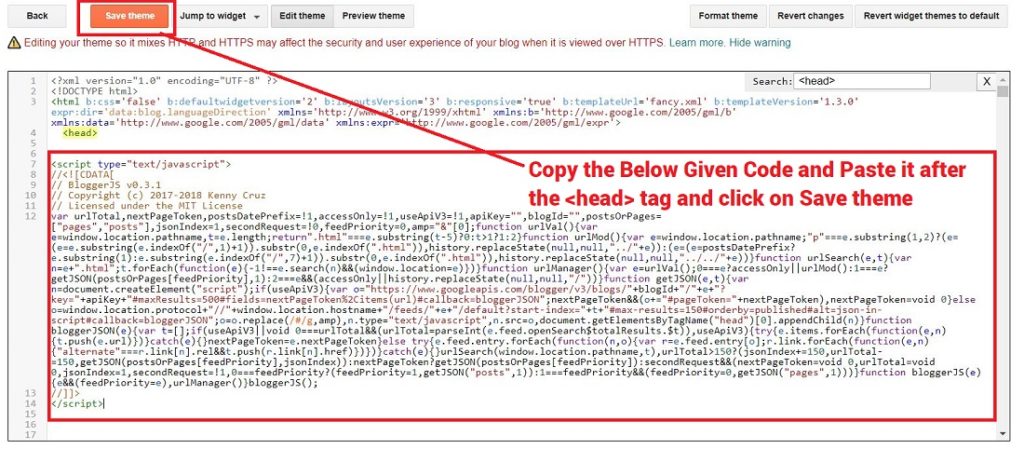
Step 4: Now, copy the following code and paste after the tag and click on Save Theme

   Code
 <script type='text/javascript'>  
 //<![CDATA[  
 // BloggerJS v0.3.1  
 // Copyright (c) 2017-2018 Kenny Cruz  
 // Licensed under the MIT License  
 var urlTotal,nextPageToken,postsDatePrefix=!1,accessOnly=!1,useApiV3=!1,apiKey="",blogId="",postsOrPages=["pages","posts"],jsonIndex=1,secondRequest=!0,feedPriority=0,amp="&amp;"[0];function urlVal(){var e=window.location.pathname,t=e.length;return".html"===e.substring(t-5)?0:t>1?1:2}function urlMod(){var e=window.location.pathname;"p"===e.substring(1,2)?(e=(e=e.substring(e.indexOf("/",1)+1)).substr(0,e.indexOf(".html")),history.replaceState(null,null,"../"+e)):(e=(e=postsDatePrefix?e.substring(1):e.substring(e.indexOf("/",7)+1)).substr(0,e.indexOf(".html")),history.replaceState(null,null,"../../"+e))}function urlSearch(e,t){var n=e+".html";t.forEach(function(e){-1!==e.search(n)&&(window.location=e)})}function urlManager(){var e=urlVal();0===e?accessOnly||urlMod():1===e?getJSON(postsOrPages[feedPriority],1):2===e&&(accessOnly||history.replaceState(null,null,"/"))}function getJSON(e,t){var n=document.createElement("script");if(useApiV3){var o="https://www.googleapis.com/blogger/v3/blogs/"+blogId+"/"+e+"?key="+apiKey+"#maxResults=500#fields=nextPageToken%2Citems(url)#callback=bloggerJSON";nextPageToken&&(o+="#pageToken="+nextPageToken),nextPageToken=void 0}else o=window.location.protocol+"//"+window.location.hostname+"/feeds/"+e+"/default?start-index="+t+"#max-results=150#orderby=published#alt=json-in-script#callback=bloggerJSON";o=o.replace(/#/g,amp),n.type="text/javascript",n.src=o,document.getElementsByTagName("head")[0].appendChild(n)}function bloggerJSON(e){var t=[];if(useApiV3||void 0===urlTotal&&(urlTotal=parseInt(e.feed.openSearch$totalResults.$t)),useApiV3){try{e.items.forEach(function(e,n){t.push(e.url)})}catch(e){}nextPageToken=e.nextPageToken}else try{e.feed.entry.forEach(function(n,o){var r=e.feed.entry[o];r.link.forEach(function(e,n){"alternate"===r.link[n].rel&&t.push(r.link[n].href)})})}catch(e){}urlSearch(window.location.pathname,t),urlTotal>150?(jsonIndex+=150,urlTotal-=150,getJSON(postsOrPages[feedPriority],jsonIndex)):nextPageToken?getJSON(postsOrPages[feedPriority]):secondRequest&&(nextPageToken=void 0,urlTotal=void 0,jsonIndex=1,secondRequest=!1,0===feedPriority?(feedPriority=1,getJSON("posts",1)):1===feedPriority&&(feedPriority=0,getJSON("pages",1)))}function bloggerJS(e){e&&(feedPriority=e),urlManager()}bloggerJS();  
 //]]>  
 </script>  

Now you have done it. If you have any problems with the previous steps, you can also watch this video tutorial.

Before This read here:

Conclusion

So, friends, I hope this article has helped all of you to extract the date from the URL of the blogger post.

If you liked the article, then share it on your social media platform, because sharing is affectionate and I’ll see you in the next one.